Can’t play around with Kathy Brown

Accidentally FaceTiming house music royalty from my pocket wasn’t perhaps the way I’d hoped the conversation would begin. I recovered my composure by remarking how having listened to Kathy Brown sing so many times it felt like meeting an old friend. She was typically reassuring: “You are meeting an old friend!” The first thing you need to know about Kathy Brown? She is seriously nice.

House music legend Kathy Brown

Like many people my first experience of her music had been in the early nineties but her roots lie in gospel with her entree into house music coming via the busy New York soul scene. “I had a friend named Karen Bernard who was one of the singers in a group called the Jones’s. New York back in the day, there were just so many artists just walked the streets! She introduced me to a guy called David Shaw who was looking for someone to sing a cover which was Can’t Play Around.” If she had any nerves about that first session, it turned out she was in the best possible hands. ”They called me at two o’clock in the morning! I met her at the studio and when I got there it was Fred McFarlane, Louie Vega, Kenny Dope, Dave Shaw — there were so many people in the studio I was like ‘Wow, OK, right then!’ They had to turn the lights down in the studio for me! And that was how I made the jump into dance music.” We moved on to talking about different producers that she’d worked with. Diplomatically she wouldn’t name a favourite, but she did give an insight into what it takes to get her attention. “If the music is good and it hits my soul, and it touches my heart, I don’t care who it is coming from! As long as the music is good music and it compliments what I’m doing.” 

Before we spoke I both did and didn’t want to ask about Turn Me Out. It was probably her most famous track certainly here in the UK and I wondered if she was sick of talking about it. She laughed, “Oh it was funny! We thought the track was funny! So we were in the studio after recording Can’t Play Around and we needed another single so we’re in the studio just bouncing ideas around, and they played the track and we each just started singing a verse. And it was just born!” Given that it arguably defined the original sound of UK garage in ‘97, it’s perhaps no surprise that the Sol Brothers Turn to Sugar remix is her favourite. “I was like OK, if you’re gonna keep doing a song, take it away from its original sound and give it something a little juicier, but still keep the same flavour in a sense…” I asked what it felt like to help define a genre. “That’s what we’re here for isn’t it? To leave our mark in what we do, and leave a stamp on whilst enjoying what we do. I feel good about it!” It’s fair to say most dancefloors since then do too.

Her music is an intrinsic part of my own musical taste, to the extent if anyone asks about what I like to play, I almost always cite her music as the best example. What would she say the special ingredient is behind the magic? “I think what all of us singers have is spirit: the spirt of giving love, of spreading love, of singing about different subjects. There’s more to singing than just singing – there’s a lot that we have to give through our singing. I would call it ministering – that’s basically what us singers are. We tell stories and as long as we can do that, that’s what keeps us strong.” These aren’t just concepts though. As she speaks there’s a clear sense of having a role to play in the lives of the people she entertains. “There’s so much going on today. Singers have lots to talk about. I think at this time it is love we need, and we do need spread a lot of it because without it, there’s nothing. I used to get people say to me ‘why do you sing so many love songs’ and I’d say ‘because we need it!’” We were speaking just as the Coronavirus pandemic was starting to gather momentum which made her underlying sense of duty all the more poignant and, to me at least, reassuring. 

And so as we drew to a close, like all good fans I was itching to know what was coming next. Lots it seemed, though she wasn’t giving too much away. “I have a track out now called Burn I did with the Brookes Brothers and Kove, so that’s out now. Ooh, I’ve done a couple of tracks so you’re gonna hear a couple of things coming for 2020 – I’ll keep the rest as a little secret, I won’t give everything away. We will be talking about them soon though!” We will indeed. This is one old friendship that I will not be turning out.

Martin Gale, March 2020

In full Effect once again

Circle March 27th 2020 on your calendar

I realised I hadn’t provided much of an update since the successful first Disco Effect fundraiser. Well, the good news is we’re doing another one!

Same logo, just in a nice shade of orange

Once more we’re raising funds for the Countess Mountbatten Hospice in Southampton and once more we’re going to be all about our favourite soulful and disco house tunes.

In a change to the last event, we’ve teamed up with one of Southampton’s best known venues, The Orange Rooms. Working together with the team there we’ve got an awesome night in store, including the chance to win some pretty amazing (and unique) prizes in our raffle thanks to a fantastic response from our friends and local businesses.

As well as being a great venue, it’s been great working with the Orange Rooms team.

So if you’re in the South Coast of the UK, 27th March should be inked on the calendar – for just £5 it’ll be the best night in town.

If you can’t make it but would like to contribute, you can always donate here.

6 steps to set up your studio for an interview

Someone asked the other day about how they could easily set themselves up in their home studio to have a guest call into their radio show for an interview.

I’ve done a few interviews from home and have found a setup and approach that at least works for me, so thought I’d share the main steps here for others to find.

Note that this pertains to a pre-recorded rather than live interview, though hardware-wise the same approach could be used.

1 – Use internet audio calling

Of course you can use the normal phone, but actually I’ve found that IP-based calling gives you almost FM-radio quality sound. All you need to do is find a version that works for you and the interviewee – e.g. FaceTime, Hangouts, Skype. I tend to use my iPad rather than my iPhone to reduce the risk of interruption.

2 – Use a splitter cable if using a device

My initial set up was as follows:

  1. My iPad running FaceTime.
  2. A jack plug to phono lead from the iPad’s headphone socket into my controller to record the interviewee’s side of the conversation.
  3. My usual studio mic to record my side at good quality.

The problem came however that positioning the iPad somewhere convenient where the iPad’s mic would pick me up sufficiently well for the other person to hear became difficult.

AKORD® Gold 3.5mm Headphone Splitter Jack Male to 2 Dual Female Cable lead audio Y-SPLITTER
An iPad/iPhone/device splitter cable – it means you can rig up a separate mic as well as taking the output into your mixer.

A splitter cable that separates the audio output from the mic input in the iPad’s headphone socket meant I could rig up a second mic right next to mine that would mean the other person could hear me clearly and I’d still get good contact for my recording.

3 – Do a dry run to check the levels

Sounds obvious but it’s worth having a dummy call with a friend beforehand to double check everyone can hear each other clearly, and that the levels are good for the interviewee side of the conversation. From experience, FaceTime can sound a bit tinny, and the level is quite low so a fiddle with the gain and the low-end is worth doing.

4 – Record the raw interview

With the above setup, at the appointed time I simply make sure I hit record on Rekordbox at the appointed time whilst the call is in progress. Because I’m using a controller, this means I can get a WAV or AIFF file directly with good quality.

Usually a good idea to record the call in its entirety – if the conversation goes well there may be some soundbites from your interviewee before or after the main conversation.

5 – Edit the raw interview recording to suit

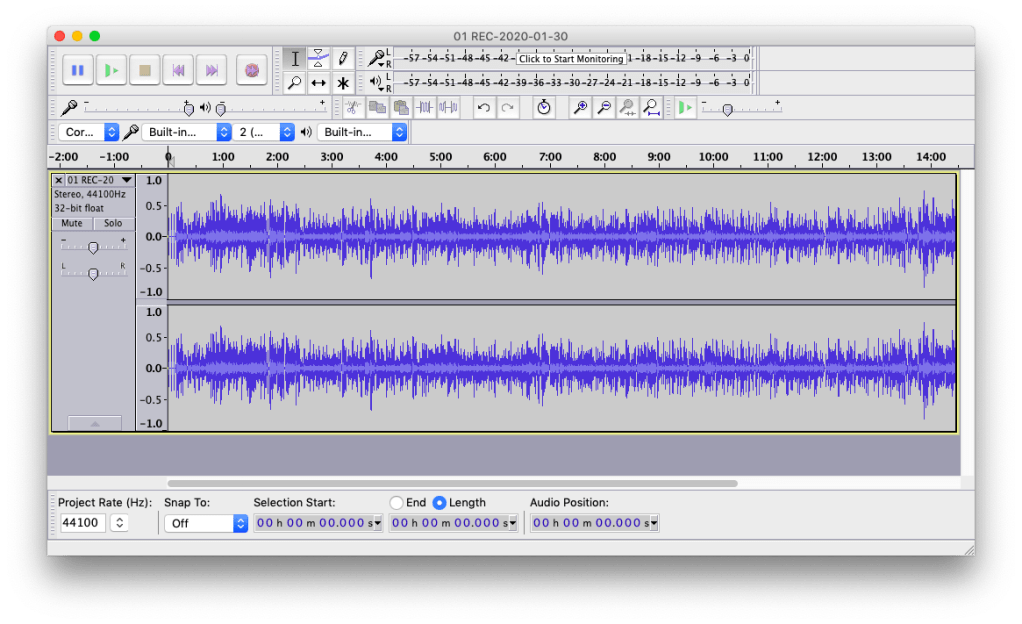
When recorded, you’ll find the raw output contains quite a lot of noise (umms, ahhs, requests for a retake etc). I tend to use Audacity to get the interview edited down so it flows, not too much dead air, and fits into the schedule I’d like.

Editing the raw interview recording down in Audacity

As I sometimes write the interview up afterwards, I may even choose to keep something back for the write-up.

6 – Create a backing track for playback

I do this ahead of the time I want to run the interview on the show simply because it’s less to worry about than trying to both create the loop and overlay the interview recording live.

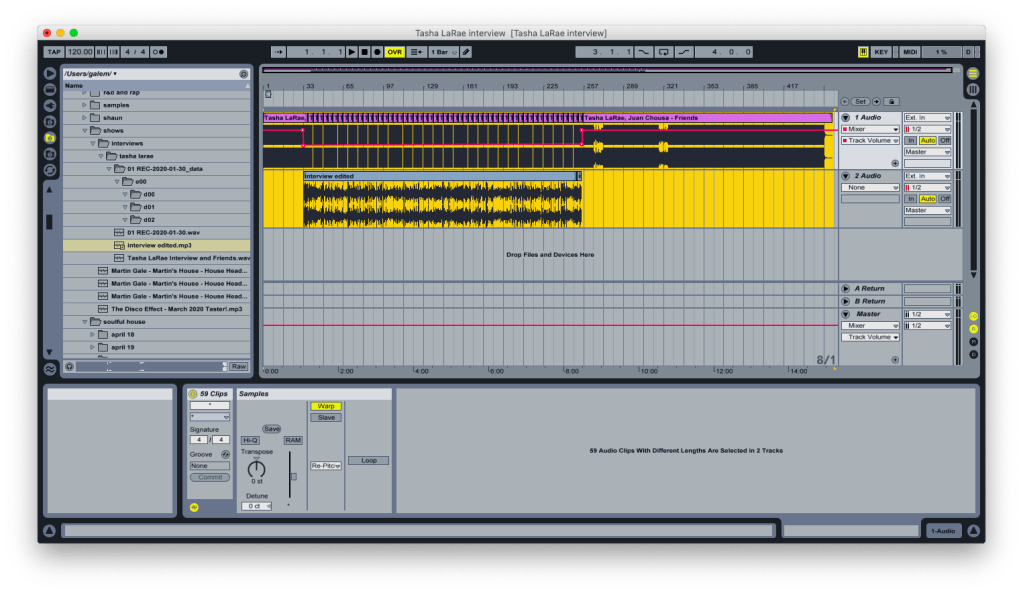
As I do a DJ mix show, I typically take a track related to the person I’m interviewing and find a suitable instrumental loop and create my own alternative version with several copies of the loop over which I paste the edited interview. I also drop the levels down so the music isn’t overpowering the interview.

Creating a combined interview and backing track for playback using Abelton.

Tools like Abelton are good for this, or even you can use good old Audacity and a bit of waveform copy/paste.

Making friends with Tasha LaRae

On spanning the genres, picking a winning track and covering the greats with confidence

Image result for tasha larae
Singer, songwriter, all round good human being Tasha LaRae

“Most of the time they find me!” I’d always been intrigued how producers and their vocalists found each other so thought I’d ask. “I’ll get a message from Spen or Tommy Davis, and they’ll say ‘hey, we got a great track for you by this cat!'” But it’s not just the big names that Tasha LaRae has time for. “Sometimes I’ll get messages from producers on social media, and I’ll take a listen to the tracks and if I like it, I go for it.” So there you have it; you can be a member of a legendary hip hop group and be one of soulful house’s leading ladies and still give everyone a fair chance. This warmth of spirit is entirely typical as I would discover during our conversation.

Now the lead female singer with Arrested Development as well as an accomplished solo artist and writer, Tasha LaRae’s journey sprang from R&B and gospel origins. “Whitney Houston, Mahalia Jackson, Yolanda Adams, and when I started getting into bands, Earth Wind and Fire and writers like Stevie Wonder, those were my influences.” She also cites Crystal Waters and Barbara Tucker from the house scene as being prominent in her development. Though interestingly she doesn’t claim to have a specific role model, she can pinpoint exactly the moment she knew her life’s work would be in music. “I remember watching the movie Sister Act 2, and watching Lauryn Hill sing His Eye is on The Sparrow. The second she started singing, something just snapped in me and I said ‘that’s what I want to do.’ I wanted to be on the other side of the television and I wanted to be singing.” At this point I had to confess to getting lost in my thoughts thinking of that iconic film scene. Thankfully she’s quick to put me at ease again, chuckling in agreement “oh my god, it was so good!”

Talking of all time greats, before we met I’d been pondering how it must have been a brave decision for her to take on Angie Stone‘s much-loved classic Wish I Didn’t Miss You in 2019. How did she approach covering such a well recognised track? “For me, when I approach doing covers, especially of someone like Angie Stone, I want to keep the integrity of the song and to make sure that whatever it is that I do it matches the best of my ability but at the same time add my little spin to it so I’m not a carbon copy of that artist.” Sound advice, and as usual there’s a practical line of reasoning. “That’s Angie Stone. You don’t get better than Angie Stone! You have to do you. To try and do better than her that just doesn’t make sense.”

Most recently though it’s been her original work that has been causing a stir. Her singing and songwriting collaboration with producer Juan Chousa Friends hit the charts in December 2019 and has been a regular play into the New Year. It’s a work that comes from the heart in more ways than one. “I fell in love with the energy of the track. You cannot deny the energy of that track. And immediately after I had phone call with one of my best friends, and it was one of those moments where I thought ‘I have the best friends in the world!’ And I just wanted to write a song about it.” At the same time, her work with Arrested Development continues, which I had reckoned might risk her getting caught between two stools. She doesn’t have difficulty switching between hip hop and house though. “I’m not an MC, I’m more associated with lyricists when it comes to that aspect of it. What I love about house music is the energy and drive is almost the exact same thing. The difference is just the BPM really.”

As our discussion draws to a close we finish by talking about what the year has ahead, and as I listen I reflect that it’s not just house music that boasts admirable energy and drive. Tasha LaRae is getting out there in 2020. “I hope to get out and about a lot more. I stayed in the studio doing a lot of writing and recording this past year so 2020, out, house parties, having a great time, travelling the world, putting out good vibes.” Including a trip to the UK, I ask hopefully? “Oh yes most definitely! I’m working on a few opportunities right now.”

And on the evidence so far, who would bet against her grasping them?

Martin Gale, February 2020

3 things vinyl DJs should love about going digital

It actually took me a while to get a controller but when I finally took the plunge in late 2017 I grew to love it. There’s just so many things a controller (or CDJ) lets you do now that software’s in control.

I wouldn’t pretend to have mastered all of them but as someone who mixed vinyl for more than twenty years beforehand there’s three features I’d definitely recommend to anyone contemplating going digital.

P.S. I’ve focused on the digital tools themselves rather than the obvious benefits of the form factor.

Loops

The loop function (as the name suggests) allows you to pick a set of bars to repeatedly loop in a track.

The loop functions on the DDJ-SX2 — most controllers or CDJs these days will have similar.

On a vinyl record you’re fundamentally limited to what’s been pressed. If there’s not much of a run in to mix with or the track ends abruptly you’re kind of stuck.

Being able to loop a section of the track, at the beginning and automatically loop a section at the end means you’ve been given the gift of time, or can afford be a bit more creative if you’re stuck with just a radio edit of something.

Cue points

Part of the art of DJing from vinyl (unless it’s DVS) is learning to spot the significant points in the track – e.g. a darker ring indicating a breakdown or vocal section. As a technique it’s not foolproof and requires a very good memory.

Whilst a digital waveform can be read to a degree on a screen I’ve always found it even harder to read than vinyl.

Hot Cues on Rekordbox – be aware though that not all CDJs show all cue points.

Hot Cues though allow you mark out the track and even give them a name so you can remember why the point is significant. Both Rekordbox and Serato DJ have this feature – they work and export in slightly different ways but the idea is the same.

I find this useful for plotting things like when the beats and melody come in and out, or when the main vocal comes in (useful for radio mic work). It only takes a few minutes to set up too.

Key analysis

There’s always those tracks that just always seem to blend together well, for example a particular accapella that went well over an instrumental or a dub. In my experience discovering a good match was largely down to chance. Also if you have a great track with no beats at the start or end, you can end up clashing with whatever’s coming next if they don’t work harmonically.

Thanks to the power of software like Rekordbox and Serato DJ we now have more chance of a nice harmonic mix since they will analyse your digital files, and tell you what key the tracks are in. If you have two tracks with matching keys, there’s a good chance they’ll blend nicely.

Rekordbox showing the key of tracks according to the Camelot Wheel.

Both Serato and Rekordbox can specify the key according to the Camelot Wheel which is an easy way of working out which keys are harmonically compatible.

Next time you are stuck with no beats to play with at the start or end of a track you’ve got the option of finding other tracks to blend together with it.